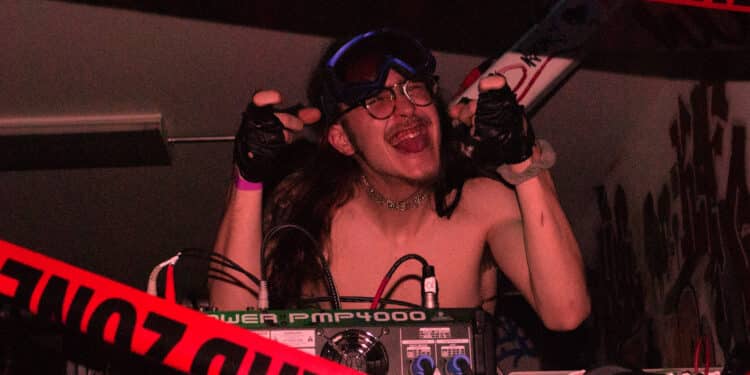



LMNOP dives into the early influences on his project, his upcoming PSYOP album, and shares his thoughts on the state of the drum and bass scene.
Los Angeles native Zach Schwartz, aka LMNOP, is on a mission to bring some fun to the drum and bass scene. While his early days were spent producing a wide range of different soundscapes, recent years have seen him hone in on the sounds of jump up to make an even bigger splash. His partner in crime, LIL Z, has become a fixture in the project, with their chemistry helping make it feel even more unique in the ever-growing scene.
Last year, LMNOP continued their rise through the ranks of the scene. The duo took the stage in support of major acts like Andy C and Hedex, throwing down some wicked sets along the way. Meanwhile, standout releases included a remix of ZOF’s “Psychosomatic” on Dome Of Doom and the flurry of tunes on Play Me Records, the esteemed drum and bass label run by Reid Speed and Alex Rosson. The latter of the two is where LMNOP will release PSYOP, a new album due out on January 30 that’s sure to be filled to the brim with drum and bass energy.
Before he releases PSYOP into the world, we caught up with LMNOP to chat about his roots, where he feels the drum and bass scene is at the moment, and what’s in store for the future. Check out his exclusive guest mix on SoundCloud, pre-save PSYOP ahead of its release, and read on for the full conversation with this rising artist in the community!
Stream EDMID Guest Mix 488 || LMNOP on SoundCloud:
Hi LMNOP, thanks so much for chatting with us today! I’m sure you and LIL Z have a unique story about how you came together for this project, so let’s start there. Can you tell us how the LMNOP project first came to life?
LMNOP started as my very first DJ name. It came from my favorite sequence of letters in the alphabet, something about the sound of it always felt playful and nostalgic. That feeling connects deeply to my childhood and to my father, who is a childrens’ singer-songwriter. Growing up around his live shows, I became obsessed with the intersection of music, performance, and storytelling.
That obsession carried through my education. I studied acting and theater from a young age and eventually studied Acting and Puppetry at the California Institute of the Arts. As I grew as a DJ and producer and began learning synthesis and sound design, I wanted LMNOP to be more than just music. I was inspired by heroes like Jim Henson and Daft Punk, who built worlds, not just records.
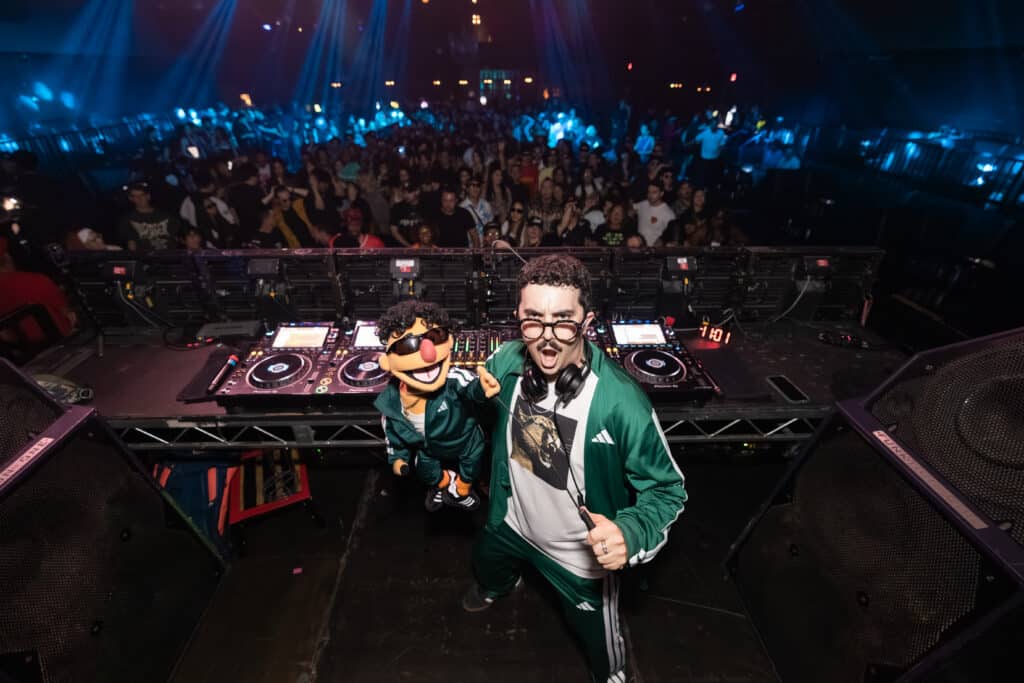
LIL Z was created as a character for a music video for my song First Time, a funky disco house track about losing your virginity. Soon, I started bringing him to parties and improvising live with ravers, where his personality really began to emerge and turn into something much bigger.
The comedy and chemistry between LIL Z and me became central to the project, and at some point, it stopped feeling like a solo act and became a duo. It all happened very organically, and that authenticity is something I really value. Over the last five years, I’ve gone deep into drum and bass, and especially jump up over the past two years. PSYOP is the culmination of that journey, both musically and conceptually.
Last year was a massive one for you. Not only did you take the stage at Hollywood Palladium to support Hedex, but you also played in direct support of legendary act Andy C. How validating were these gigs for you on your journey? Can you speak to their importance?
Those shows were huge for us, not just from a career perspective, but emotionally as well. It felt like we were rising alongside the momentum of drum and bass itself, and that everything aligned at exactly the right moment. Having seen both Hedex and Andy C perform multiple times before those gigs, I was inspired by the intensity, passion, and intention they bring to their performances.
As a relatively newer drum and bass artist in the U.S., being validated by pioneers of the genre, both from the newer generation and the old guard, meant more than I could have ever imagined. Drum and bass is a genre people take very seriously, and breaking through isn’t easy, even for artists who’ve been grinding in the scene for decades.
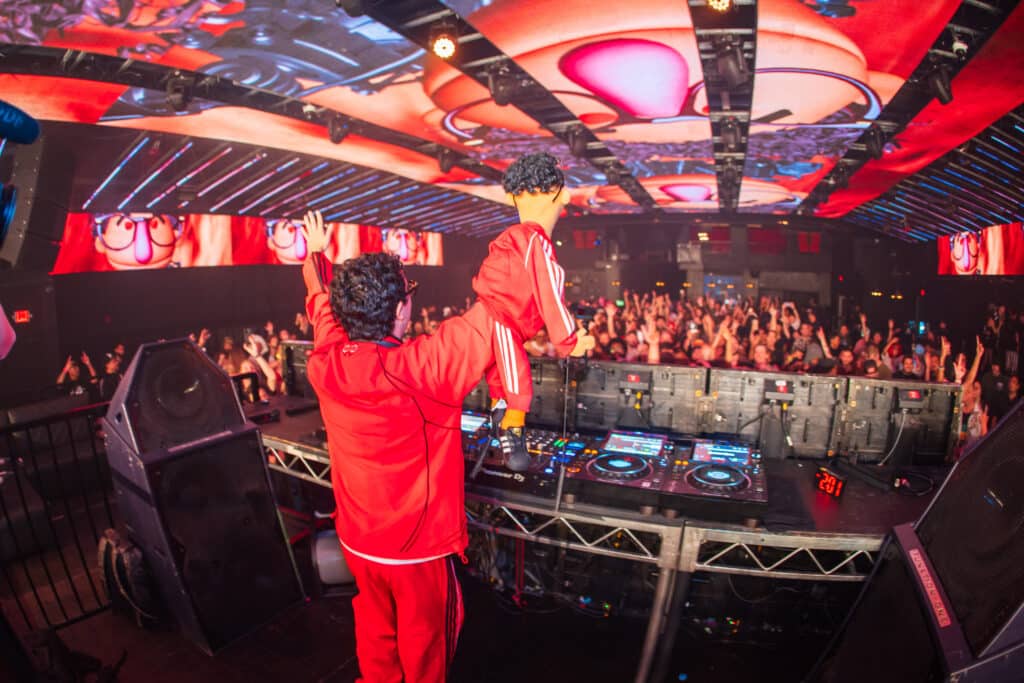
Standing on stages like that, surrounded by my best friends and family, and feeling the crowd truly respond to my original music was incredibly affirming. Those gigs didn’t change our direction, but they confirmed that the path we’re on is real and worth committing to fully.
Flashing forward to the present, you’re in the lead-up to releasing your sophomore album, PSYOP. What was the production process like for this release? How long did it take from start to finish?
PSYOP came together over the last year and a half, during a period where I went fully all-in on jump up drum and bass. The sound really clicked with the LMNOP project, especially after already diving deep into the drum and bass world through releases on Space Yacht, RAM, Viper, and Play Me. It felt like a natural evolution rather than a pivot.
The album’s foundation began with the track “Birds Aren’t Real,” inspired by the viral conspiracy movement that took off in 2022, claiming birds had been replaced with government spy drones. With the way the political and media landscape has shifted over the past few years, it often feels like we’re surrounded by psychological operations designed to divide us, to the point where every conspiracy theory starts feeling at least partially plausible.
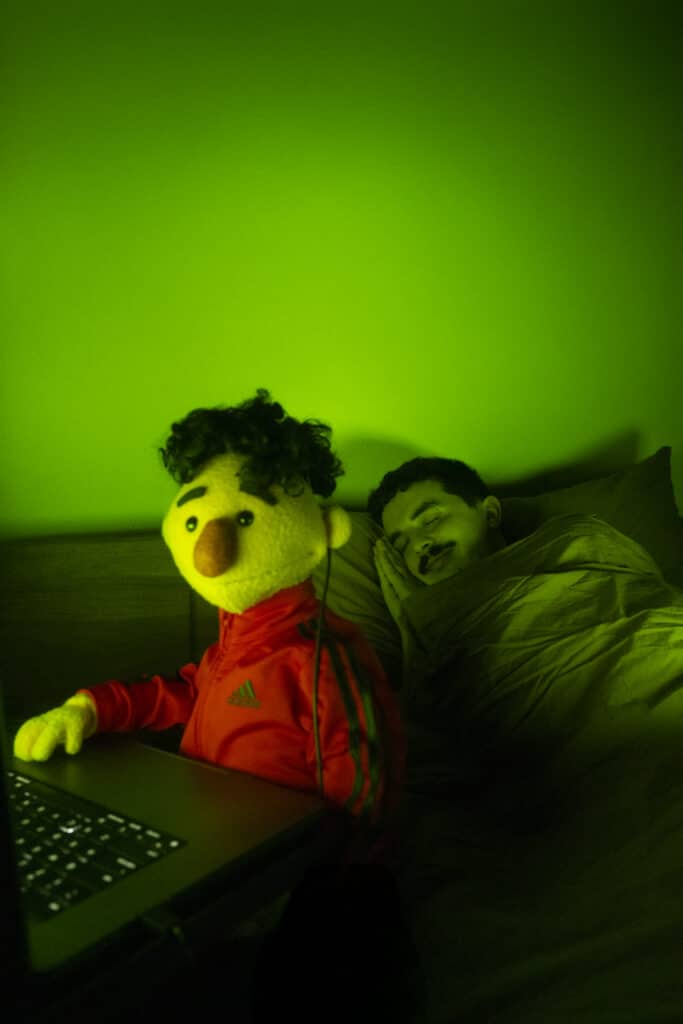
That idea sparked a deeper narrative and led me to rethink LIL Z’s origin story. In the world of PSYOP, I create LIL Z and accidentally leave him plugged into the internet overnight. He ends up downloading the entire internet into his mainframe, crashes the global web, and becomes sentient with god-like intelligence. He wakes up knowing too much. That moment is the opening of the album.
From there, the story unfolds as LIL Z pulls me down the rabbit hole, revealing hidden truths about reality and a shadowy underworld I never knew existed, one that’s actively trying to obtain him for far more dangerous purposes. Every track had to function on two levels, delivering impact on the dancefloor while advancing the story. Sonically, it’s very rooted in Jump Up, but there’s a cinematic backbone tying everything together into a cohesive experience rather than just a collection of tracks.
The album is set to land on Play Me Records. As a rising artist, how important has it been to have the backing from such a beloved label in the scene?
It’s been absolutely pivotal to my career development. Play Me has such a deep legacy within bass music, and Reid Speed has always believed in us as artists, not just producers making club records. That level of trust takes a lot of pressure off and gives you the freedom to be bolder and more experimental without second-guessing your vision.
For a rising artist, that kind of backing is huge. It obviously opens doors, but more importantly, it reinforces the idea that you don’t need to water yourself down to be successful. You can lean fully into who you are and trust that the music will connect.
Reid Speed and Alex Rosson, who run Play Me, truly deserve more recognition for helping launch so many careers in the bass music scene. Beyond that, they’ve both been incredibly supportive of me from the very beginning. Huge shout-out as well to Aaron Simpson, who does so much behind the scenes to make these releases actually happen. I’m extremely grateful to work with Play Me and will always consider it my family label.
While your recent releases have firmly been rooted in drum and bass, you’ve dabbled in other genres like tech house along the way. How does your love for a broad spectrum of genres impact your work in the studio?
I’ve honestly been all over the gamut genre-wise. My first full-length album on Dome of Doom, Alphabet Soup Vol. 1, was intentionally wide-ranging, pulling from house, baile funk, hip hop, and beyond. At the time, not being hyper-defined sonically actually gave me the foundation to later be very specific about my sound. Exploring different genres taught me what I was drawn to and what I wanted to refine.
Even now, when we’re fully locked into Jump Up, those influences still seep in. On PSYOP, you can hear that in crossover tracks like “Moves Like Fire,” “Keep It Down,” and “Automata.” Elements like arrangement, groove, negative space, and overall sound design are all shaped by cross-genre curiosity. We’re not trying to mash genres together for the sake of it. Instead, those outside influences help keep our drum and bass dynamic rather than formulaic.
Drum and bass hasn’t always been the most popular genre, but recent years have seen its following grow significantly. What do you feel helped foster its latest push forward in the scene?
I think a few key things have aligned at the right time. There’s definitely a generational shift happening where younger listeners are gravitating toward faster tempos and more high-energy dance music. Drum and bass scratches that itch in a way very few genres can, especially since it’s one of the foundational bass music styles.
Its connection to MC culture is also incredibly powerful. The vocal elements, call-and-response energy, and memorable hooks give people something to latch onto and participate in. That communal element is a huge part of why the genre works so well live.
Social media has lowered the barrier to discovery, and at the same time, artists have stopped trying to make drum and bass sound uniform. Producers are pushing boundaries again. Because of that, you’re seeing legacy acts who’ve been doing this for 20 years experience a real resurgence, while newer artists are stepping in with fresh perspectives.
What’s especially beautiful is seeing younger ravers and longtime drum and bass heads sharing the same dancefloor. One of the things that originally drew me to the genre was the way people danced at drum and bass stages. It felt different, more physical and expressive.
From a production standpoint, drum and bass has always been intimidating because of the level of technical skill it demands. But with technology and production knowledge being more accessible than ever, the overall quality has skyrocketed. That just raises the bar for producers like myself, and honestly, I’m excited by that challenge.
What does drum and bass, and its community, mean to you on a personal level?
Family. That’s really the core of it for me, and also the last song on PSYOP. I’ve never felt as accepted as an artist as I have within the drum and bass community, especially here in Los Angeles. Drum and bass has always felt like a refuge for people who don’t neatly fit into boxes. The scene values energy, dedication, authenticity, and individuality in a way that feels genuine.
I also feel incredibly lucky to be surrounded by a community of artists who truly support one another. Being able to call people like Dr. Apollo, Skellytn, Reid Speed, Siren, Tima Dee, Berto Antonio, MC Dino, Dip Vertigo, and dela moon peers and friends, has meant a lot to me. That mutual respect and encouragement is something I don’t take for granted.
The dance music community has always been there for me, and that sense of belonging means everything.
Where do you see the genre headed in the near future?
I think the genre will continue to diversify while staying true to its core. You’ll see bigger crossover moments on a global level, alongside a strengthening of underground scenes that keep drum and bass grounded in its roots. More artists are going to focus on identity and storytelling, not just writing bangers, and I definitely see myself as part of that next wave.
I also think the U.S. will become a major driving force in the genre’s growth over the next few years, especially as UK MC culture continues to collide with U.S. hip-hop and R&B influences. That fusion feels natural and really exciting.
The genre is healthiest when it allows the old and the new to coexist, and from where I’m standing, that’s exactly where drum and bass is headed.
Finally, since there’s a whole year ahead of us, what goals do you hope to achieve throughout 2026?
2026 is starting strong with the release of PSYOP on January 30. Right out of the gate, we’re planning an album pop-up, a release show, and eventually a remix competition. I’m really excited to see how the community reinterprets the project and pushes it in new directions, because that kind of interaction is incredibly important to me.
Beyond the release, the focus is on expansion on multiple levels. We want to bring the live show to more places, deepen the world around the project, and continue pushing the visual and narrative side forward. I’m planning to develop the PSYOP storyline into a comic and expand it into a full LIL Z saga, where the music becomes just one piece of a much larger universe.
I’m also looking to collaborate globally with like-minded artists and build more bridges in the dance music space. I’ve already got unreleased music in the vault that I know is going to make waves this year.
More than anything, my goal is to foster a real community through ongoing content with LIL Z and evolve the live show visually by using technology in creative ways.
Follow LMNOP:
Website | Facebook | X | Instagram | SoundCloud | YouTube | TikTok